Tuesday, June 5, 2012

What Happened To The Local Loquats?

Loquat-Rose Butter

This will be Part One Of - What Happened To The Local Loquats?

I have been in a particularly experimental mood lately.  Dangerous?  Well, yes, actually, though, I do realize that not all of my food adventures are going to become future blog posts or even be edible for that matter.

I am thinking of a particular batch of loquat butter I made recently.  You are probably wondering what could go wrong with a batch of loquat butter?  Especially since I have made loquat butter before with Carrisa, summer 2010, when we were both very pleased with the result.

Well things went off for me this time when I reached for the jar of wildflower honey and grabbed double-delight rose honey instead, and a rather assertive double-delight rose honey at that.

I did not even realize what I had done until I tasted the loquat butter.  And even then, it took me a moment or two to figure out what the flavor configurations were that were happening on my tongue.  The unlikely rose/loquat combination, oddly enough the loquat tree and rose bush that the petals are harvested from actually live in close proximity to one another in my mother's backyard and have unfortunately managed to get into even closer proximity, falls into the category of flavor confusion to downright flavor weirdness.  Don't bet me wrong.  I have nothing against double-delight rose honey, in fact, I think it is delicious, but it has no business with loquats.  Big sigh.

So I did what I almost always do when faced with a food crisis.  I fermented it!  Of coarse, what else!

So, I added some salt and some probiotic powder, for beneficial bacteria, and left the offending jar on the counter for a couple of days. 

It did not help.

My next plan is to take the little food orphans to Carrisa and see what she can make of them.  She is much more of a baker than I am.  Perhaps she can reinvent them and bake them into luscious loquat quick bread or spicy loquat muffins?  I AM STILL hopeful.

I am heading out of town tomorrow, and you guessed it, I am taking the loquat butter with me.

Monday, June 4, 2012

Sweet Potatoes - The Taste Test

Sweet Potato

This post is dedicated to one of my favorite foods, the large starchy sweet-tasting tuberous root vegetable known as the sweet potato.  Always fond of a good sweet, I decided to conduct a taste test.  I baked four different varieties of sweet potato, if anybody knows of other varieties I will gladly taste test them too, pictured above, which I got from one of my favorite local growers at the farmer's market.

Sweet Potato - Four Varieties

The sweet potato, believed to have originated somewhere in South or Central America, is a member of the same plant family as the morning glory flower.  The orange fleshed variety, often mislabeled as a yam, is actually a sweet potato and not a true yam at all.

The garnet or jewel variety of sweet potato, pictured above in the right hand corner, a good source of complex carbohydrate, beta-carotene, vitamin C, and Vitamin B-6, has beautiful coppery-red skin and brilliant orange flesh.  The flesh of the orange sweet potato is moist, almost sticky, and deliciously sweet.

The yellow sweet potato, pictured on the top left corner, has light brown skin and yellow flesh.  The flavor is delicate, mild, and pleasantly sweet.

The dazzling purple sweet potato, or Okinawan sweet potato, pictured above, is amazingly rich and sweet tasting.  The skin of the Okinawan is a light buff color and the flesh is truly a magnificent velvety, over-the-top purple.  The Okinawan is a great source of the antioxidant anthocyanine, don't try to say that one too fast, which is only present in red, blue, and purple food.

Other foods that are rich in anthocyanine are blueberry (my favorite berry!), elderberry (I am always on the look-out for them!), cranberry, billberry, raspberry, blackberry, blackcurrant (makes suburb jam!), cherry (another favorite!), chokecherry (my mother's favorite childhood jelly), eggplant peel, black rice (my favorite rice!), concord grapes (my favorite grapes!), muscadine grapes, purple cabbage, and violet petals (my favorite edible flower!).  Oh!  And red-fleshed peaches contain anthocyanine.  I just discovered that I am rather enthusiastic about anthocyanine containing foods!

Kindly, nature and agriculture have provided us with some additional and uncommon sources of anthocyanine containing foods such as the blue fleshed potato, purple broccoli, purple cauliflower, purple carrots, blue corn, and blood orange.  Love that color!

And finally, getting back to to our subject of the day, the Japanese sweet potato, pictured above on the bottom right, sometimes called Satsuma-imo, is a beautiful tuber, (does that sound oxymoronic?) with rose-violet skin and white flesh that deepens to a marbled translucence when baked.  It has a lovely sweet flavor that is especially appealing.

My current sweet potato preference, though subject to change when I get a random sweet potato that is so unexpectedly near perfection that it becomes the sweet potato of the moment, is Satsuma-imo, with Okinawan being a close second, followed by the vivid orange fleshed sweet potato, and finally, last but not least, the yellow fleshed sweet potato.

Though there are many, often elaborate, ways to prepare sweet potato I like mine simply prepared, either baked or roasted with butter.

Sunday, June 3, 2012

How to Make Simple Pressed Salad


Pressed Salad

I realize that I have mentioned pressed salad in any number of posts.  So this time I will include pictures and detailed instructions.

Pressed salad, delicious and refreshing, is a lovely compliment to just about every meal.  Vegetables can be pressed for a minimum of two hours and for upwards of two days.  The longer the vegetables are pressed the more they will resemble probiotic-rich pickled vegetables.  The shorter the vegetables are pressed the more they will resemble a vegetable salad.  The idea is to prepare a raw enzyme-rich salad that is easy to digest.

Sliced Organic Green Cabbage

Slice about 4 cups of green cabbage, napa cabbage, or purple cabbage.  You can add a few stronger greens such as collard greens, kale, or dandelion greens for variety.

Sliced Root Vegetables

Cut root vegetables such as red radish or daikon radish into thin slices.

Celery, Red Radish, And Carrot

Add a variety of your favorite garden vegetables for variety, color and flavor.

Combine Vegetables in Glass Bowl

Mix vegetables in a glass bowl with about 1/2 tsp. to 1 tsp. sea salt per 4 - 8 cups of vegetables.

Pound With Surigogi

Massage vegetables by hand or pound vegetables with a wooden surigogi for about 10 minutes.  The vegetables will begin to soften and become  juicy. The salt and the pounding, or massaging, helps to break down the cellulose in the vegetables.

Press with Weight

Press the vegetables by nesting another glass bowl on top of the salad and weight it with a bottle of water or vinegar.  Let the salad press for a minimum of 2 hours and upwards of two days.

Simple And Elegant Pressed Salad

Squeeze out the juice and serve pressed salad just as it is or with a squirt of fresh lemon juice, lime juice or rice vinegar.

Saturday, June 2, 2012

On The Subject Of Macrobiotics

In case your introduction to Japanese food culture was not sushi then it was most likely macrobiotics. 

In yesterdays post "Japan - My Adopted Food Culture" I highlight some of the health benefits of traditional Japanese food practices.   In today's post we will take a look at macrobiotics, which is essentially a variant form of Japanese food culture, which was introduced to this country in the 1960's by its creator George Ohsawa. 

The macrobiotic diet consists of the following: 

Whole grains, especially brown rice: 40 - 60% 
Vegetables: 25-30% 
Bean and Legumes: 5 - 10% 
Miso Soup: 5% 
Sea Vegetables: 5% 

In addition to these basic guidelines seafood, fruit (with the caveat that one not eat fruit from the tropics), natural sweeteners such as brown rice syrup and barley malt, and nuts and seeds may be enjoyed two to three times a week.  There is a list of vegetables that are recommended as well as those to be avoided.

At a glance, the macrobiotic diet, which bears a striking resemblance to the U.S. government food pyramid dietary recommendations, may seem like a "healthy" diet.   In fact many, believing that to be the case, have adopted this variant form of the Japanese food culture in order to claim or re-claim a "healthy" lifestyle. 

One of the things I appreciate about macrobiotics is the sincerity and fervor of its community. 

While I appreciate the diligent allegiance of its proponents, ultimately, I must question the efficasy of a diet that is conspicuously lacking in important macro-nutrients such as protein and fat, not to mention the fat-soluable vitamins, Vitamin A, D,E, and K2.  My primary criticism of the diet is that it essentially removes all of the virtues of the traditional Japanese diet, all of the most nutrient dense and nourishing parts of that food culture, the fish, shellfish, eggs, and fish roe and leaves you with a rather drab nutrient-deficient diet enhanced only by a smidgeon of pro-inflammatory seed oils such as sesame oil, corn oil, and tahini. 

While the traditional Japanese diet has ample omega-3 fatty acids, from fish, the macrobiotic diet is almost totally devoid of EFA's.  The diet, with its exclusion of meat, eggs, and cheese is deficient in B-12, folate and other important B-vitamins.  It is very low in protein and without adequate animal fat it is low in vitamin A, D E, and K2. The diet is notoriously low in calcium, magnesium and zinc.  It can be deficient in vitamin C as well.

In my mind the macrobiotic diet is a psuedo-Japanese diet fashioned to fascinate an American public, who bereft of a national food identity, are quite literally "starving" for authentic food traditions.  While many of us have adopted, or attempted to adopt, this restrictive form of Japanese food culture I wonder how many have actually thrived on it? 

While there may be a place for a macrobiotic diet in the short-term it is not a diet that will sustain long-term health and growth.  At best the macrobiotic diet, with its emphasis on whole, unprocessed organic food, could be an improvement on the SAD diet, and be beneficial as a sort of modified and temporary "food fast" for those recovering from extreme dietary excess.  It is not, however, a diet for young children or those who are in their reproductive child-bearing years. 

Sally Fallon, author of "Nourishing Traditions" has this to say:

Macrobiotic enthusiasts consider rice the most perfect grain, in which the yin and yang energies are in equilibrium.  But the Westerner should not necessarily adopt Oriental rice-eating habits. Asians have larger pancreas and salivary glands in proportion to body weight than Westerners, and these traits make them ideally suited to a grain-based diet.  The Westerner who adopts the strict macrobiotic or Oriental diet, with rice at every meal, may develop serious health problems."

As an aside there is a yearly macrobiotic gathering in the Tahoe National Wilderness each year which I have enjoyed attending periodically.  One has the opportunity at camp to listen to many lectures, often heavy on the theoretical side of things, on the subject of macrobiotics, while the kitchen and cooking classes pick up the more practical aspects of macrobiotics. 

As you may have gathered from previous posts, despite my criticism of macrobiotics, I am really quite fond of the food.  I can wax eloquent on the subject of sea vegetables, pressed salad, and baked kabocha squash.  But, I am not a fan of extreme diets. 

That being said one of the better stories I heard at camp that year came from a fellow of German extraction.   He told us that he had made a trip to Germany and while at a German beer hall was invited to join in with others for a meal of sausage and beer.  Faced with the uncomfortable prospect of compromising his restrictive dietary ideals he wondered how he could "gracefully" get out of the situation.  He wondered if he should not order a cup of chamomile tea and retire early to his bed.   Eventually at some point in his mental cogitations he was able to move from "dour compliance" to rigid dietary principles to "hail fellow well met" in his decision to partake in the food and fellowship that was being offered him with gusto.  He ended up having a marvelous and memorable evening, I am told, and, most importantly, I might add, without suffering any adverse effect from his dietary dalliance.  In fact, he was surprised to find that the next morning he felt wonderfully refreshed and revived for it.

Friday, June 1, 2012

Japan - My Adopted Food Culture

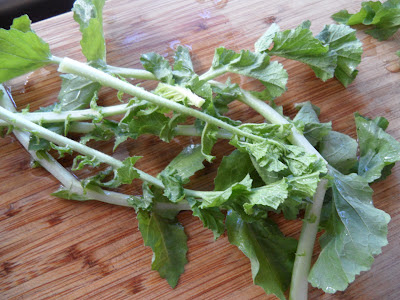
Beautiful Daikon Radish Greens

Today we will look at some of the many health benefits of my favorite adopted food culture.

Rather than focus on recent Japanese food trends such as an ever-increasing appetite for imported western-style food or the super artificial "kawaii" cutsy/adorable (aka Hello Kitty) bento box convenience meals that are so popular with the young, we will take a look at traditional Japanese food culture and see what it brings to the table.

EAT SEASONALLY

Japanese food is all about perfection and seasonal timing.  The traditional Japanese diet does not only favor seasonal food, it CELEBRATES seasonal food!

While it is true that seasonal eating will require that we periodically "suffer" through times of scarcity when a particular food is not abundantly available or in season, please bear in mind that when the food IS in season that it will taste SO MUCH BETTER. Think of styrofoam-out-of-season pink tomatoes.  Is anybody tempted?  The big pay off with eating seasonal food, not food imported from half way around the world, is that you can fully enjoy the food at its most exquisite moment of perfection.

LOCAL FLAVOR

Traditional Japanese food is authentic honest food that derives its character from its native land and sea.  Japan is an island nation and the essence of traditional Japanese food is the delicate balance of flavor - the distinct briny flavor of the sea married to the earthy flavor of the land.  The marriage of land and sea (did you see the film documentary "Jiro Dreams Of Sushi?') is the magical essence of traditional Japanese food culture.

One of the most powerful and provocative things we can do on a daily basis, no matter where we live, is to eat food that is locally produced as often as we can.  Local food is fresher, more nutritious, and tastes better.  Local foods are authentic foods that strengthen health and connect us to our place in the world in an intimate and authentic way.

Rather than imitating the Japanese genius for food flavor, unless, of coarse, you happen to live in Japan, what would be an authentic expression of your food culture?

BEAUTIFUL FOOD

Traditional Japanese food is beautiful to look at.

When we make food look beautiful and appealing to the eye, even taking into consideration the beauty of negative space on the plate, food is infinitely more satisfying.  We can eat slowly and savor the flavor and texture of the food.  When food is beautifully and artfully prepared we literally eat the food with our eyes before we take the first bite.

LESS IS MORE

From the land of the rising lifespan, the Japanese being the longest lived people on the planet, comes this old Japanese saying, "hara hachi bu," which roughly translates to "eat until you are 80% full."

Coming from a society that glorifies the "all you can eat" mentality this may seem counter-intuitive at first, but, as we train ourselves to be satisfied with less food we will reap health benefits, if only in increased energy and improved digestion!

WHAT DO THE JAPANESE EAT?

FISH AND SEAFOOD - Most people think that the Japanese diet is primarily a vegetarian rice diet, but, fish and shellfish, rich in omega-3 fatty acids, are actually the staple food of Japan.  The average person in Japan consumes roughly 154 pounds of fish a year.  That is about one-half pound per day.

VEGETABLES - The Japanese consume about five times more green and cruciferous vegetables, such as kale, cabbage, broccoli, Brussels sprouts, watercress, Chinese cabbage, radish, cauliflower, and turnips, than the average American.

SEA VEGETABLES - Kombu, nori, arame, hijiki, and wakame are plentiful in Japan.  Sea vegetables are an important part of Japanese cuisine and contain high amounts of iodine, which helps protect thyroid health, as well as other minerals and important micro-nutrients.

PICKLED VEGETABLES - No wonder I love Japanese food!  Fermented vegetables are served with every traditional Japanese meal!  Pickled vegetables, which are high in B-vitamins, are usually eaten at the end of a meal to aid digestion.  Daikon radish pickled in rice bran is one of my favorite Japanese pickles.

RICE - Rice, short grain rice being most highly favored, is the staple grain of Japan.  Interestingly, rice is relatively low in phytic acid, compared to other gluten-containing grains, and according to Sally Fallon, rice does not require the overnight soaking and special preparation methods that other grains require.

Wednesday, May 30, 2012

Rice To The Rescue


Okayu - Japanese Rice Porridge
Today's post is dedicated to one of my favorite comfort foods.

RICE TO THE RESCUE

When I fell in love with Japanese cuisine over two decades ago, while attending a macrobiotic health conference in Santa Barbara, California, I had no idea that it would become my favorite adopted food culture.  When I am feeling under the weather it is Japanese food that I turn to for my remedy of choice.  I don't know what it is about Japanese food, but it has become my quintessential comfort food. When I have an occasional tummy upset, or tension in my neck, what my acupuncturist often refers to as liver qi overpowering stomach qi, nothing hits the spot like a comforting bowl of okayu, or Japanese rice porridge, with a bit of umeboshi plum, which is aptly called Japanese alka-seltzer, or sliced scallion. Okayu, the eastern equivalent to a bowl of oatmeal, is light, bland, and infinitely easy to digest.

As an interesting aside, Sushi rolls, in fact, when I am sick my husband will usually run out and buy a sushi roll for me at Whole Foods Market, a bowl of miso soup, and baked mochi, likewise, all seem to have, what I consider, a near miraculous curative effect.

RECIPE FOR OKAYU - Serves 1 - 2

1/2 c. white or brown short grain rice
4 c. water or chicken stock
1 - 2 inches kombu sea vegetable
small piece of ginger root
1/2 t. sea salt


Rinse rice well.  Place all ingredients in a small crock pot.  I have one from chef mate that I like. Turn the crock pot on low and simmer for 8 hours or over night.

 Follow Me on Pinterest

Tuesday, May 29, 2012

Tracing A Food Lineage

With an emphasis on ancestral food culture and "The Perfect Diet" todays post will visit a bit of obscure family food history on my mother's side of the family.

My ancestors on my mother's side of the family hail from Wales and England.  Is it any wonder that I remember my grandparents fondness for fruitcake and custards, and roast leg of lamb?  I certainly wish someone had written down the recipes!  One of the things that the early immigrants and settlers, my ancestors among them, brought with them to this country was their native food culture which they transplanted, as best they could, in the new world, and in the case of my maternal ancestors, who are the subject of today's post, in the arid rocky mountain west.

My great grandfather was a dry farmer.  I don't think that means he did not drink, though he did not, I believe that means he prayed for rain, which, indeed, I am certain that he did!  He and my great grandmother managed to raise a family of eight children together in one of the isolated and lonely valleys of the rocky mountain west.

My grandmother, Mimi, the eldest child, remembers baking eight wheaten loaves of bread each day in a wood burning stove.  I am certain they would be considered poor by todays standard and when times were particularly tough I am told that my great grandparents fed their eight hungry children a dish, known in the food annals of the pioneer west, as Lumpy Dick.  From what I can surmise from my grandmother's rich, and possibly embroidered, descriptions of it, with her Welch love of story telling, along with what I have gathered on the internet (see recipe below) - Lumpy Dick appears to be a sort of hasty pudding, as it were, and if we were to "leap the pond," so to speak, and re-visit their native food culture, Lumpy Dick may very well be a derivative or close relation to a traditional English dish called Spotted Dick.

If you trace the lineage of Lumpy Dick even further, it is my conjecture that it finds its origins in an old relic of medieval cuisine called "frumenty." Frumenty (sometimes frumentee, furmity, fromity, fermenty) was essentially a nourishing pottage made from boiled, cracked wheat that was cooked with milk, eggs, or broth and sometimes contained currants and sugar.

I will go even further in my conjecture, to speculate, with my avid interest in all things fermented, that frumenty, may originally have been a naturally fermented sour porridge.  See notes below.

Those of you who remember Thomas Hardy's novel "The Mayor of Casterbridge" will remember well the notorious dish of furmity served with a slug of rum and the catastrophic circumstance that one dish of furmity set in motion.

Here is a benign and harmless recipe for Lumpy Dick that I found on an internet search and which may or may not be similar to the dish my grandmother ate.

Lumpy Dick

1 egg
2 1/2 c. milk
3/4 c. flour
salt
sugar, honey, or molasses

Heat 1 1/2 c. milk just to a boil.  Break egg into flour.  Stir with a fork until lumpy.  Add enough milk so that it can be poured, lumps and all.  Salt to taste as desired.  Pour the lumpy mixture into the milk heated just to boiling and cook for 15 minutes. Serve in soup dishes with the rest of the milk poured over it and sugar, molasses or honey to sweeten.

TRADITIONALLY PREPARED GRAINS

When grains are traditionally prepared and allowed to naturally sour or ferment the anti-nutrient factors, such as phytic acid, that are present in the grain and place a tremendous burden on the pancreas, are neutralized and nutrients become more bio-available.  For more information on the importance of the proper preparation of grain and grain products I refer you to Sally Fallon's marvelous article "Be Kind To Your Grains..."

 Follow Me on Pinterest
